
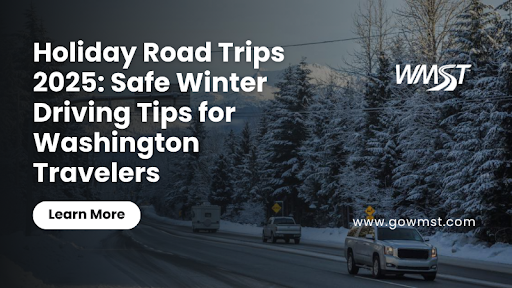
As the 2025 holiday season approaches, many in Washington are planning safe road trips WA to see family and friends. But unlike a summer drive, a winter trip—especially over the passes—requires a serious plan. According to the Washington State Department of Transportation (WSDOT), major corridors like I-90 (North Bend to Cle Elum) and US 2 (Skykomish to Stevens Pass) will see significant congestion, especially the weekend before Thanksgiving and the days leading up to Christmas.
This combination of heavy traffic and unpredictable weather makes holiday travel safety a top priority. Being a safe winter driver isn’t just about having 4-wheel drive; it’s about preparation, patience, and a defensive mindset.
Preparing Your Vehicle for Cold Weather
Before you pack the gifts, prep your car. A breakdown in a cold, remote area is a preventable emergency.
- Tires are Everything: Your tires are your only connection to the road. Check your tread with the “penny test” (if you see all of Lincoln’s head, your tread is too low). Ensure all four tires are inflated to the correct pressure (found on the sticker inside your driver’s door).
- Check Your Fluids: Top off your windshield washer fluid with a winter-grade, de-icing formula. Ensure your coolant/antifreeze is rated for cold temperatures.
- Test Your Battery: Cold weather is the #1 killer of weak batteries. If your battery is more than 3-4 years old, have it tested for free at most auto parts stores.
- See and Be Seen: Install winter wiper blades and ensure your defrosters and all headlights/brake lights are working.
- Plan Your Route: Make sure you know where you are going and have back-up routes if a pass is closed. Check the weather and pass conditions frequently before leaving.
How to Drive Safely on Snowy and Icy Roads
Your driving habits must change the moment the pavement is wet or icy. The posted speed limit is for ideal, dry conditions, not for snow.
The Safest Speed on Icy Highways
This is the most critical rule: Reduce your speed by half or more. If the speed limit is 60 mph, you should not be traveling faster than 30 mph. On truly icy patches, you may need to go as slow as 5-10 mph. The safest speed is whatever speed allows you to maintain full control and avoid sliding.
Key Icy Road Precautions
- Increase Following Distance: The 4-second following distance we teach at WMST is the bare minimum for dry roads. On snow, double it to 8 seconds. On ice, you need at least 10 seconds of space.
- Avoid “Black Ice”: Be extremely cautious on bridges, overpasses, and in shaded areas, as they freeze first and can host “black ice”—a thin, invisible layer of ice that looks like wet pavement.
- Make No Sudden Moves: All steering, braking, and accelerating must be slow, smooth, and gentle. Jerky movements will cause a skid.
- NEVER Use Cruise Control: Never use cruise control in wet, snowy, or icy conditions. You need to be in 100% control of your speed and acceleration.
- How to Handle a Skid:
- Do NOT brake. This is the most common, and wrong, instinct.
- Ease your foot off the accelerator.
- Steer into the skid. Look where you want to go, and gently turn the steering wheel in the same direction the rear of your car is sliding.
Essential Items for Your Winter Road Trip Kit
A winter emergency kit is a non-negotiable for safe road trips WA. If you get stranded, it can be a lifesaver.
- For You: Blankets, warm clothes (hats, gloves, boots), a flashlight with extra batteries, a cell phone power bank, non-perishable food (energy bars, nuts), and water.
- For Your Car: A first-aid kit, an ice scraper and snowbrush, a small shovel, jumper cables, traction mats or a bag of sand/kitty litter, and road flares or reflective triangles.
WMST’s Specialized Winter Driving Training
At WMST, we know that driving in Washington means driving in real-world weather. Our curriculum is designed to build confident, defensive drivers who are prepared for these exact scenarios.
While simulations can’t teach you the feel of a car on a wet road, our six full hours of actual, behind-the-wheel instruction can. Our professional instructors coach you through rain and other adverse conditions, building the muscle memory and calm confidence you need. Our WMST winter lessons and advanced courses focus specifically on skid control, hazard perception, and the defensive mindset that will protect you and your family this holiday season.
Frequently Asked Questions (FAQs)
Are snow chains required on the Washington passes?
Yes. Per WA snow chain rules, all vehicles (including 4WD/AWD) are required to CARRY approved traction tires or chains when traveling over mountain passes from November 1 to March 31. Signs will be posted when you are required to INSTALL chains. Four wheel drive and all-wheel drive vehicles do not have to install chains if signs indicate “chains required”, but must carry them in the vehicle and install them if the signs indicate “chains required for all vehicles.” Studded tiresare not a substitute for chains; if chains are required, they must be installed. Failure to use chains when required can result in a $500 fine.
What should I keep in my car for winter trips?
Your kit should include blankets, warm clothes, food, water, a flashlight, a first-aid kit, an ice scraper, jumper cables, and a traction aid like sand or kitty litter.
How do I avoid sliding on icy roads?
Reduce your speed by half, increase your following distance to 8-10 seconds, and make all movements (steering, braking, accelerating) as smooth and gentle as possible. Be especially cautious on bridges and overpasses.
Does WMST offer snow or skid control lessons?
Yes. WMST offers advanced driving lessons and winter driving courses that are specifically designed to give you hands-on experience with skid recovery, traction limits, and the defensive driving techniques needed for snow and ice. Call our office to ask about the schedule.
What’s the safest speed to drive on icy highways?
The posted speed limit is for ideal conditions. On icy roads, you must reduce your speed by at least half. If the road is truly icy, the safest speed may be as low as 5-10 mph. If you are sliding at all, you are going too fast.
Check Back: Techsslash!
Leave a Reply